

01 | Nuclear Power Plants: The Most Stringent Firestopping Requirements Among All Industrial Facilities
Among all industrial facilities, nuclear power plants consistently impose the most stringent requirements on fire safety. A single cable penetration through a fire-rated wall, if improperly sealed, will result in consequences far beyond ordinary property loss — within the nuclear island environment, the spread of smoke and flame can easily compromise the independence of safety systems, potentially triggering a Level 1 nuclear safety event.
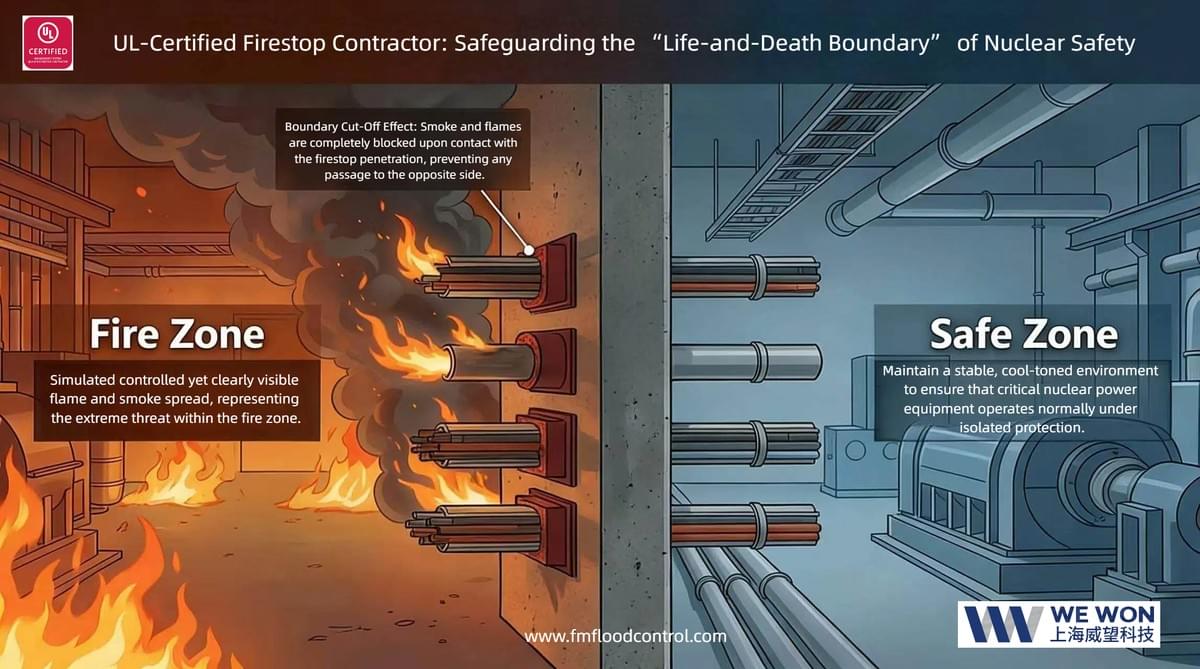
Nuclear Safety Incident Warning Case
In 2019, a nuclear power plant in Europe was directly listed as a “Significant Improvement Area” during a WANO (World Association of Nuclear Operators) peer review due to missing firestop maintenance records. This led to delayed overhaul of the unit, and the contractor involved had its qualification suspended. This serves as a critical warning: in the nuclear sector, the traceability of firestopping is now directly linked to nuclear safety culture.
02 | Why Conventional Firestopping Cannot Meet Nuclear Power Requirements?
(Nuclear Fire Protection Hard Requirements: Minimum fire resistance of 3 hours in nuclear island areas | Compliance with U.S. NRC regulatory framework 10CFR50 | 100% documentation traceability for every penetration point)
Firestopping in nuclear power plants is by no means a simple “sealant filling” task. It is subject to an extremely stringent nuclear QA/QC system review. Every penetration record may be traced item by item during IAEA safety inspections or insurance audits.
❌ Fatal flaws of non-certified construction:
· Lack of quantifiable standards: Workers lack systematic training and rely solely on visual judgment and experience to determine filling density;
· Material risks: Use of materials not listed by internationally recognized authorities such as UL, making fire resistance performance unquantifiable;
· Documentation gaps: No unified numbering or ledger management for penetration points, resulting in no traceable records during audits;
· High compliance risks: Unable to withstand rigorous on-site inspections by independent third-party institutions (such as IAEA or FM).
Core demand from nuclear owners:
What owners require is not something that merely “looks properly sealed,” but a firestop system that is documented, independently verified, and fully compliant with international certification standards — which is precisely the fundamental significance of introducing UL QFCP certification.
"Nuclear fire protection is not a construction activity; it is a quality assurance program. Every penetration seal must be traceable, verifiable, and independently inspected."
— Excerpt from IAEA Safety Guide NS-G-1.7: Nuclear Power Plants Fire Protection
03 | UL QFCP Certification: The “International Passport” for Nuclear Procurement Systems
UL QFCP (Qualified Firestop Contractor Program) is the highest-level specialized certification system established by Underwriters Laboratories for firestop contractors. Certified organizations are subject to continuous audit and supervision by UL Solutions and must strictly follow UL-listed system installation methods.
In nuclear projects, UL QFCP certification holds irreplaceable value compared to conventional qualifications:
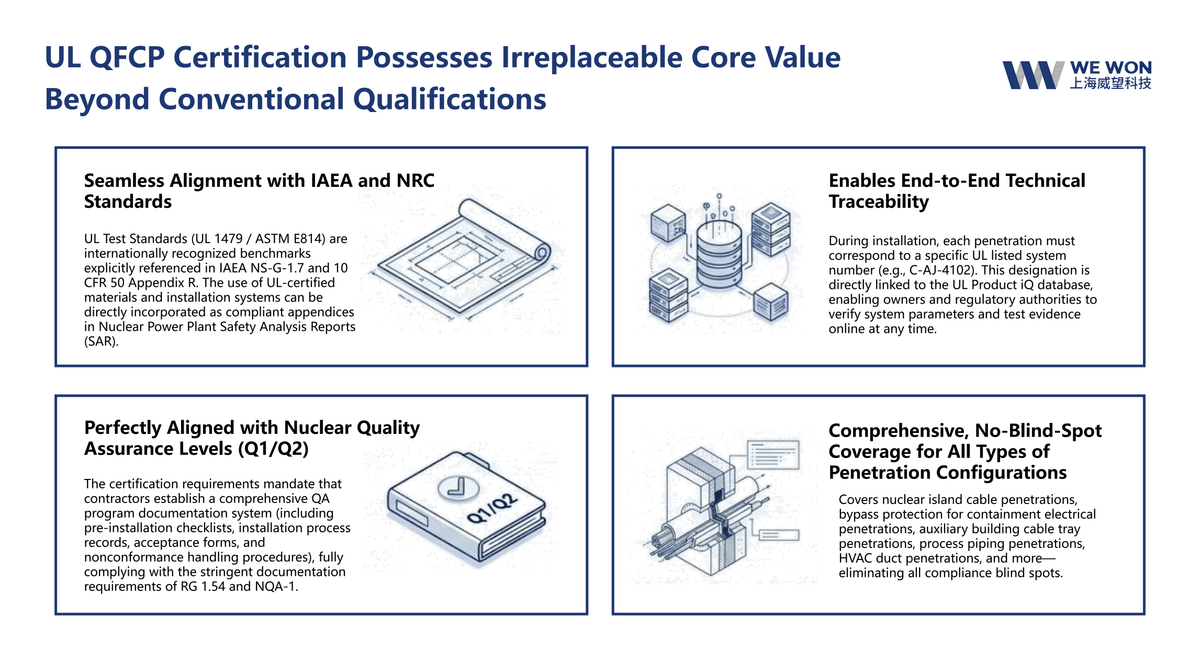
UL test standards (UL 1479 / ASTM E814) are explicitly referenced by IAEA NS-G-1.7 and 10CFR50 Appendix R as international benchmarks. The use of UL-certified materials and systems can be directly incorporated into the nuclear plant Safety Analysis Report (SAR) as legitimate appendices.
② End-to-end technical traceability
Each penetration must correspond to a specific UL listed system number (e.g., C-AJ-4102). This number is directly linked to the UL Product iQ database, allowing owners and regulators to verify system parameters and test bases online at any time.
③ Full compliance with nuclear QA levels (Q1/Q2)
Certification requires contractors to establish complete QA documentation systems (including pre-installation checklists, construction records, acceptance forms, and non-conformance procedures), fully aligned with the stringent documentation requirements of RG 1.54 and NQA-1.
④ Comprehensive coverage of all penetration configurations
Covers nuclear island cable penetrations, containment electrical bypass protection, auxiliary building cable tray penetrations, process piping penetrations, HVAC duct penetrations, etc., eliminating all compliance blind spots.
04 | ILAC Third-Party Independent Inspection: Independent Verification to Eliminate “Self-Assessment” Blind Spots
Construction certification addresses “who performs the work and how,” while third-party independent inspection answers “whether it was done correctly and whether deviations exist.” Both are indispensable.
ILAC (International Laboratory Accreditation Cooperation) is the world’s highest-level accreditation platform for testing and inspection, covering over 100 economies. Inspection reports issued by ILAC MRA-accredited bodies have internationally recognized legal validity.
Why must nuclear power plants introduce ILAC-accredited inspection bodies?
Acceptance of nuclear firestopping cannot rely on contractors acting as both “player and referee,” nor solely on simple internal owner reviews. IAEA GS-R-3 and HAF 003 clearly require that nuclear safety-related activities must establish independent quality verification mechanisms separate from construction entities.
ILAC-accredited institutions possess specialized technical capabilities, standardized inspection methodologies, and are fully independent of contractor interests. Throughout the firestopping lifecycle, they undertake four key responsibilities:
· 01 Pre-Installation Review: Independently assess design schemes, verify that selected UL system numbers match actual site configurations (substrate material, opening size, cable fill rate), and issue independent technical opinions.
· 02 In-Process Inspection: Conduct proportional or full inspections of critical parameters (e.g., mineral wool density, wet film thickness ≥12.7 mm, penetration fit gaps), strictly recording deviations and non-conformities.
· 03 Final Acceptance Inspection: Verify consistency between documentation and actual conditions point by point, conduct non-destructive or destructive sampling for questionable areas, and issue ISO/IEC 17020-compliant inspection reports for archiving.
· 04 Periodic In-Service Inspection: Perform periodic re-inspections during overhaul cycles, identify risks caused by later disturbances, aging, or non-compliant modifications, and provide corrective action recommendations.
05 | Synergy Effect: UL-Certified Construction × ILAC-Certified Inspection Quality Loop
The two certification systems control “execution” and “verification” respectively, complementing each other to form an unbreakable nuclear firestopping quality defense line:
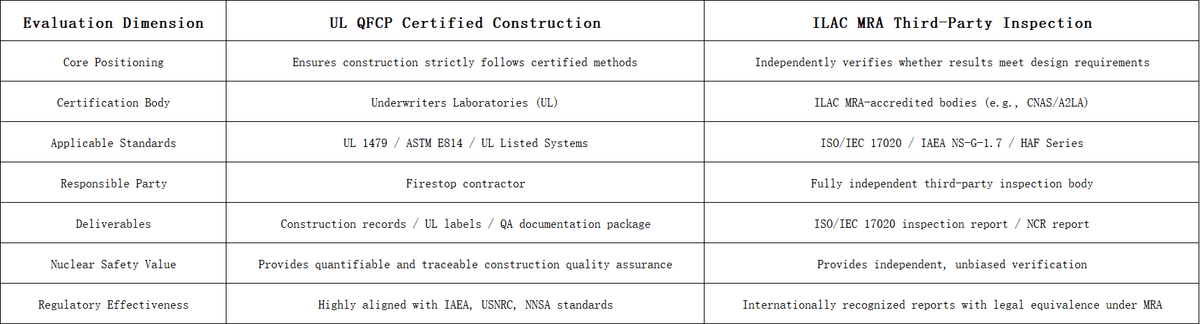
UL QFCP certification proves “we know how to build correctly,” while ILAC inspection proves “an authoritative independent body has verified that it was indeed done correctly.” Both are indispensable under rigorous nuclear safety audits.
06 | WE WON Solution: A Complete Dual-Certification Closed Loop
Shanghai Weiwang Technology Co., Ltd. is one of the very few professional firestopping organizations in mainland China possessing the following top-tier certifications simultaneously:
UL QFCP Certification: Qualified firestop contractor under UL, subject to continuous strict audits.
FM APPROVED: Use of FM-certified materials meeting global industrial insurance requirements.
CNAS / CMA: Nationally accredited laboratory testing reports with ILAC MRA international mutual recognition.
In nuclear projects, Weiwang provides a full lifecycle one-stop service from design to maintenance, and can coordinate ILAC-accredited third-party participation to establish a fully independent dual-layer quality defense system of “construction + inspection”:
Site survey & firestop audit: Systematically identify all penetration points and establish baseline records with risk prioritization.
UL system matching design: Precisely match optimal UL-listed systems via UL Product iQ database and issue detailed design documentation.
UL QFCP-certified construction: Executed by certified teams with strict control of key parameters such as mineral wool density and wet film thickness (≥12.7 mm).
Digital traceability system: Assign unique IDs to each penetration and record full lifecycle data, achieving 100% traceability.
ILAC independent inspection coordination: Ensure complete separation between construction and inspection documentation.
In-service maintenance & overhaul inspection: Provide periodic inspection and repair services to maintain long-term compliance.
07 | Empowering Nuclear Owners: Confidently Facing Stringent Compliance Audits
Choosing the integrated solution of “UL QFCP-certified construction + ILAC-certified third-party inspection” provides not only impeccable engineering quality, but also confidence in facing the world’s most stringent nuclear safety audits:
· Pass IAEA peer reviews (WANO/OSART): Provide internationally recognized documentation for fire compartment integrity.
· Meet NNSA inspections: Complete QA evidence chain with construction + third-party reports.
· Satisfy FM insurance audits: The highest-level compliance combination.
· Support license renewal: Long-term traceability and inspection records support extended operation licenses.
· Facilitate new unit acceptance (EPR / Hualong One / AP1000): UL QFCP serves as the most direct international credential.